
There is a particular kind of confusion that sits underneath every peptide and SARM forum thread, and it goes something like this: if the before-and-after photos look fine, the compound must be fine. Nobody posts a photo of their liver panel. So the public record ends up skewed toward the success stories, and the failures live somewhere most people never think to look: medical journals, case reports, FDA advisories. This piece went looking there, not to settle a culture-war argument about supplements, but to answer a narrower question. Is the risk talk around peptides and SARMs mostly exaggeration, or is there a documented pattern of real harm sitting underneath it?
The short answer is that the pattern is real, it is well documented, and it is almost entirely concentrated on one side of the comparison. Here is how to make sense of it.
The confusion: a shortcut that looks clean until it isn’t
SARMs, short for selective androgen receptor modulators, are marketed on the promise of an anabolic effect without the traditional steroid downside. That pitch is appealing precisely because it sounds plausible: bind the receptors in muscle and bone, skip the rest. What gets lost in that pitch is that the selectivity is theoretical, and the human case reports tell a much messier story.
The clarification: three clocks, running at different speeds
Reading through the published literature, three separate timelines stood out, each measuring a different kind of harm.
The liver clock. A 24-year-old man developed cholestatic liver injury after five weeks of RAD-140. His peak total bilirubin reached 38.5 mg/dL, a biopsy confirmed drug-induced cholestasis, and the clinicians who treated him wrote plainly that RAD-140 and other SARMs should be used judiciously and under close clinical supervision until better safety data exist [P1]. A separate case describes a 29-year-old bodybuilder who developed jaundice and markedly elevated liver enzymes about four weeks after starting a SARM supplement, with a biopsy again showing cholestatic drug-induced injury [P2]. A third case involves a 52-year-old who used higher-than-recommended doses of LGD-4033 for three months and was diagnosed with drug-induced liver injury after other causes were ruled out [P3]. Three different SARMs, three different ages, the same organ failing in the same way, on timelines measured in weeks to a few months rather than years.
That pattern lines up with what the FDA has said publicly: products containing SARMs carry the risk of life-threatening reactions including liver damage, along with an increased risk of heart attack and stroke, and despite being marketed as supplements, they are unapproved drugs that have never been reviewed for safety [P6]. When a federal regulator and a scatter of independent case reports point at the same organ, it stops looking like an isolated incident and starts looking like a pattern worth taking seriously.
The hormone clock. This one does not send anyone to the hospital, at least not immediately, which is part of why it is easy to miss. A controlled study of LGD-4033 in healthy young men found that just 21 days of dosing produced dose-dependent suppression of total testosterone, sex hormone-binding globulin, and HDL cholesterol [P4]. Nobody in that study felt sick. Their bloodwork simply changed, quietly, inside three weeks. That is the kind of harm a person cannot self-diagnose by looking in the mirror.
The label clock. This is the one that undercuts the “I do my research” defense that shows up in nearly every forum thread. Researchers purchased 44 products sold online as SARMs and tested what was actually in them. Only 52% contained the SARM listed on the label. About 25% contained undeclared substances, and roughly 39% contained a different unapproved drug entirely [P5]. Put plainly: for a large share of buyers, the compound they researched, dosed carefully, and tracked in a spreadsheet was not the compound in the vial. Careful use assumes an honest label. The label, it turns out, is a coin flip.
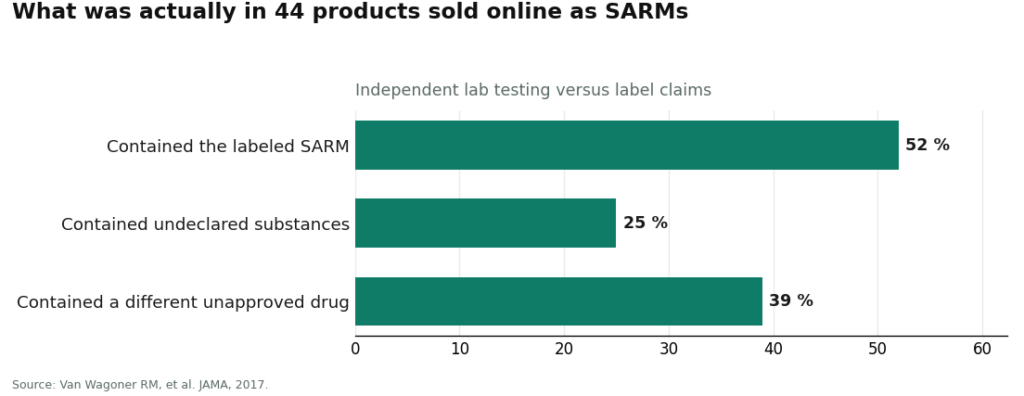
Stack these three clocks together and a clearer picture emerges than any single case report gives on its own. The harm did not require years of misuse, it showed up in otherwise healthy people in their twenties and fifties, and it arrived through two different channels at once, one loud (jaundice, hospitalization) and one silent (hormone suppression that only shows up on a blood panel). A person chasing visible results from a bottle they bought online has no reliable way to notice the invisible half of that equation happening in real time.
The sensible path: the real variable isn’t the category, it’s accountability
It would be tidy to say peptides are the safe alternative and stop there, but that is not quite honest either. “Peptides” is not one thing. The category spans FDA-approved medications with large clinical trial programs, medications a licensed pharmacy compounds against an actual prescription, and research-status compounds with thin human safety data. That last group deserves the same scrutiny as any SARM, and pretending otherwise would just be trading one kind of hype for another.
What actually separates the two categories is structural, not chemical. On the peptide side, a supervised route exists: a licensed clinician can evaluate someone, write a real prescription when appropriate, and a licensed pharmacy can dispense something it has actually tested. On the SARM side, that route does not exist at all, because nothing in the category is approved to prescribe in the first place. Even where an individual peptide’s evidence is thin, the path to using it can still include someone who is professionally accountable for the decision. A SARM, by definition, cannot offer that.
FormBlends is one example of what that supervised route looks like in practice: a physician-supervised telehealth service where a clinician reviews the patient, writes a prescription when it’s appropriate, and licensed pharmacies handle the dispensing. It’s mentioned here as an illustration of the accountable model, not as a product recommendation, and there is nothing to buy on this page. The useful detail is that a provider built this way structurally cannot dispense the compounds behind the liver-injury case reports above, because no approved version of those compounds exists to prescribe. The accountable providers are, by design, walled off from the exact products doing the documented damage.
The takeaway
The evidence does not support treating “peptides versus SARMs” as a clean rivalry between two supplement categories. The more useful question is whether a licensed person is accountable for what ends up in the vial. On the SARM side, the record includes healthy people with drug-induced liver injury [P1][P2][P3], a federal warning naming liver, heart, and stroke risk [P6], hormone suppression inside three weeks [P4], and mislabeling in roughly half of tested products [P5], with no supervised route available for any of it. On the peptide side, the evidence genuinely varies by compound, but a supervised path exists for the ones with real prescribing infrastructure behind them. That difference, not a category label, is the one worth paying attention to.
Answers to the common questions
How fast can SARMs cause liver injury? Faster than most people assume. In the published case reports, a 24-year-old developed cholestatic liver injury after roughly five weeks of RAD-140 [P1], and a 29-year-old bodybuilder became jaundiced about four weeks after starting a SARM supplement [P2]. These were healthy people, and the injury showed up on a timeline of weeks, not years of misuse.
Are SARMs legal to buy, and are they approved for use? No SARM is an approved drug, and none can be legally prescribed. The FDA states that products containing SARMs are unapproved drugs sold illegally as supplements, carrying the risk of life-threatening reactions including liver damage, heart attack, and stroke [P6]. Being marketed as a “research chemical” does not mean a product has passed any safety review.
Can buying from a trusted SARM source lower the risk? Not reliably, because the label itself is frequently wrong. When researchers tested 44 products sold online as SARMs, only 52% actually contained the labeled SARM, about 25% contained undeclared substances, and roughly 39% contained a different unapproved drug altogether [P5]. Careful dosing cannot compensate for contents that are a coin flip.
Can SARMs affect hormones even if bloodwork feels fine day to day? Yes, and that is exactly the point. A controlled study of LGD-4033 in healthy young men found that 21 days of dosing produced dose-dependent suppression of total testosterone, sex hormone-binding globulin, and HDL cholesterol [P4]. This kind of harm doesn’t announce itself; a person can feel completely normal while it happens, which is precisely why bloodwork and a clinician matter.
Are peptides simply safer than SARMs? It depends on the specific peptide and, more importantly, on whether a licensed professional is accountable for it, not on the category label alone. Peptides range from FDA-approved medications to prescription-compounded products to research-status compounds with thin safety data, and that last group merits the same caution as a SARM. The structural difference is that a supervised path exists for peptides, one that includes a licensed clinician and pharmacy. No such path exists for SARMs, since none can be legally prescribed.
What’s the sensible way to approach either option? Work with a licensed clinician instead of a gray-market seller. For peptides, that can mean a route where a clinician evaluates the person, writes a prescription when it’s appropriate, and a licensed pharmacy dispenses a tested product, an approach FormBlends illustrates. No equivalent supervised route exists for SARMs, so a clinician accountable for a patient’s safety simply cannot dispense them.
References
- A 24-year-old man developed cholestatic drug-induced liver injury after five weeks of RAD-140, peak total bilirubin 38.5 mg/dL; authors urged close clinical supervision. RAD-140 Drug-Induced Liver Injury. Ochsner Journal, 2022. https://pubmed.ncbi.nlm.nih.gov/36561105/
- A 29-year-old bodybuilder developed jaundice and biopsy-confirmed cholestatic drug-induced liver injury about four weeks after starting a SARM supplement. Selective Androgen Receptor Modulator Induced Hepatotoxicity. Cureus, 2022. https://pubmed.ncbi.nlm.nih.gov/35340496/
- A 52-year-old developed drug-induced liver injury after three months of higher-than-recommended LGD-4033, diagnosed by exclusion. LGD-4033 and a Case of Drug-Induced Liver Injury. Cureus, 2024.
- LGD-4033 (ligandrol) over 21 days in healthy young men produced dose-dependent suppression of total testosterone, sex hormone-binding globulin, and HDL cholesterol. Basaria S, et al. J Gerontol A Biol Sci Med Sci, 2013.
- Of 44 products sold online as SARMs, only 52% contained the labeled SARM; 25% contained undeclared substances and 39% contained a different unapproved drug. Van Wagoner RM, et al. JAMA, 2017.
- Products containing SARMs carry the risk of life-threatening reactions including liver damage and the potential to increase the risk of heart attack and stroke; they are unapproved drugs, not dietary supplements. U.S. Food and Drug Administration.
None of this is an endorsement of SARMs. They remain unapproved, investigational compounds with documented liver, cardiovascular, and hormonal-suppression risks, and no SARM can be legally prescribed anywhere. Among peptides, some are FDA-approved or prescription-compounded medications; compounded medications themselves are not FDA-approved finished drug products. Anyone weighing a decision here should talk with a licensed clinician first.
Are peptides and SARMs actually legitimate, or mostly hype?
It depends entirely on which specific compound is meant and how it’s being obtained. Some peptides, certain growth-hormone-releasing ones in particular, have genuine clinical research behind them. SARMs, on the other hand, have no approved human use anywhere as of now, and every SARM product sold to consumers sits in legal gray territory at best. A before-and-after photo online is not evidence of safety, and it was never meant to be.
What actually separates peptides from SARMs?
Peptides are short chains of amino acids, many of a kind the body already produces on its own. They tend to act through signaling pathways, nudging the body toward something it already knows how to do, like releasing growth hormone. SARMs are synthetic small molecules engineered to bind androgen receptors in muscle and bone while, in theory, leaving other tissues alone. That selectivity sounds elegant on paper, but clinical trials have repeatedly shown the separation isn’t clean, and side effects have cut more than one trial short.
What do these products typically cost, and what does that price actually get you?
Research-chemical sites price SARMs anywhere from $40 to $150 a bottle, with peptide vials landing in a similar range. What that money buys is genuinely uncertain, since independent lab testing has found a significant share of these products misdosed, contaminated, or simply different from what the label claims. Physician-supervised compounding pharmacies like FormBlends operate under state pharmacy board oversight, which at minimum means someone is accountable for what actually goes into the vial.
Which works better for body composition, peptides or SARMs?
Neither has an FDA-approved indication for body composition in healthy adults, so any “which is better” argument leans on bodybuilding forums and small, sometimes industry-linked studies. Peptides such as CJC-1295 or ipamorelin carry a more favorable short-term safety signal in the available data. SARMs showed early promise in trials for muscle-wasting conditions, but several were shelved after liver toxicity and cardiovascular signals emerged. Choosing a “winner” between two unregulated options is a bit like arguing over which speeding ticket is the safer one to get.
Written by Dario Eriksen, evidence reviewer. Last reviewed February 2026.
For reference only. A qualified clinician can tell you whether any of this applies to you.